News | Giro d'Italia | Team • May 4, 2026
Adam Yates to lead UAE Team Emirates-XRG charge at the Giro d’Italia
Emirati squad heads to the first Grand Tour of the season with a squad capable of competing on all fronts, from Bulgaria to Rome

Ahead of the 109th edition of the Giro d’Italia, UAE Team Emirates-XRG is delighted to announce its eight-strong lineup. Running from Bulgaria to Rome, the 2026 Giro will see Adam Yates head up an ambitious and highly capable team that will look to show itself both in the general classification and in stage-hunting.
From the team car, directions will come from Sports Directors Fabio Baldato, Marco Marcato and Manuele Mori, whilst Yates will bring his years of know-how to the race known as La Corsa Rosa.
There, he will be joined by Igor Arrieta, Mikkel Bjerg, Jhonatan Narváez, Marc Soler and a pair of Grand Tour debutants in Jan Christen and António Morgado.
As the first Grand Tour of the season, the Giro d’Italia is a race in which UAE Team Emirates-XRG has enjoyed much success in recent years. The Emirati squad has been on the podium in each of the last three editions, with Tadej Pogačar’s victory in 2024 bookmarked by João Almeida’s third-place finish in 2023 and Isaac del Toro’s runner-up spot last season.
The team’s first-ever Grand Tour stage victory came at the 2017 Giro d’Italia, with the now-Sports Director Jan Polanc picking up a memorable win on the stage to Etna. Since then, UAE Team Emirates-XRG has gone on to win 16 further stages of the Giro, through riders such as Pogačar, Del Toro and Brandon McNulty.
Speaking ahead of this year’s edition, Yates made clear his optimism for the team to race on the front foot across all three weeks.
Yates: “I’m pretty happy with how my preparation for the Giro has gone. The win in O Gran Camiño was a good tester and I’ve had a solid block with the team in Sierra Nevada, so I think as a group we’re ready.
“Not having João Almeida will change our strategy slightly, but we still have big ambitions and still want to go for results. Personally, I feel like the shape is good and if things go our way we can have a good crack at the GC and animate the race.”
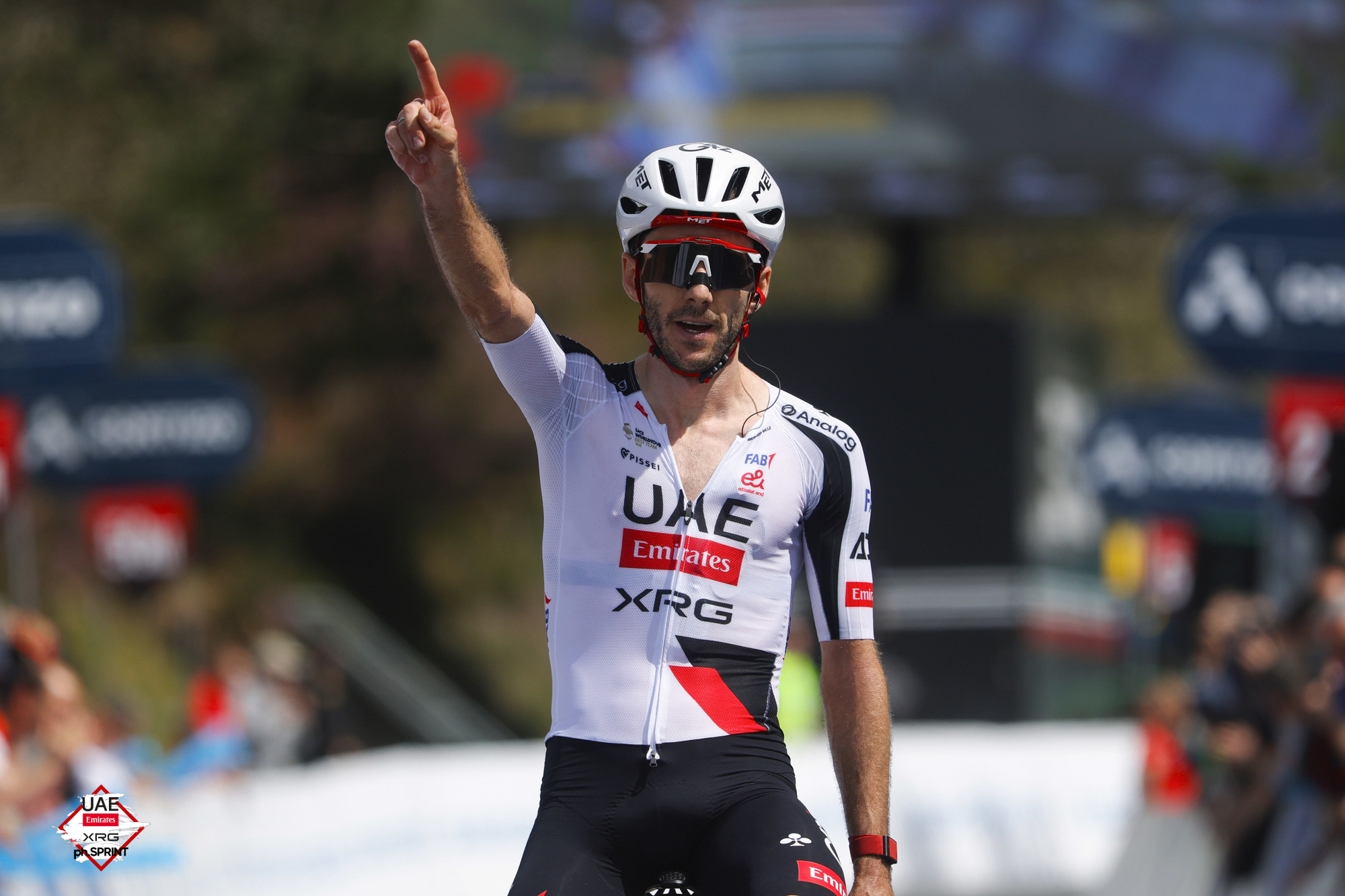
At 33 years of age, Adam Yates heads into the Giro d’Italia fresh from winning the general classification at O Gran Camiño last month. There, the British climber moved to 34 victories in his professional career, and laid down a marker ahead of a great opportunity in Italy.
It has been nine years since Yates’ debut at the 2017 Giro d’Italia, in which the man from Bury placed ninth overall and took no less than seven top-10 stage placings along the way. Making his Giro return last year, Yates played a crucial role in Del Toro’s breakout performance and came into his own in the final week.
Across his three full seasons to date with UAE Team Emirates-XRG, the 33-year-old has won a stage apiece at the Tour de France (2023) and the Vuelta a España (2024), with only the Giro d’Italia missing to complete the set.
A former podium finisher and yellow jersey-wearer at the Tour de France, Yates is no stranger to mounting a consistent challenge across three weeks, and the Brit will start the race full of optimism.
Elsewhere, Grand Tour debutants Jan Christen and António Morgado already have 15 professional victories between them, and will not shy away from the challenge. The experience of their teammates will be crucial as they navigate their way through their first three-week races.
For experience, the pair need not look further than Marc Soler, who has ridden 16 Grand Tours to date in his lengthy career. Still only 32 years old, the Spaniard will make his first appearance at the Corsa Rosa for UAE Team Emirates-XRG, and with a stage victory at last year’s Vuelta a España fresh in the memory, Soler will certainly spot his opportunities.
Jay Vine has twice ridden the Giro d’Italia before with UAE Team Emirates-XRG, and across 2023 and 2025, the Australian has picked up four top-10 placings in individual time trials. The Australian national time trial champion will have his eyes firmly glued on this year’s race against the clock on stage 10.
Igor Arrieta’s only Grand Tour to date was last year’s Giro, in which the young Spaniard played a big role in Del Toro’s success, and also rode himself to fourth on a stage from the breakaway. It was a good first outing for the 21-year-old, and he will be keen to follow suit this time round.
Finally, the Giro d’Italia has been firmly in the sights of both Jhonatan Narváez and Mikkel Bjerg since the pair crashed out of the Santos Tour Down Under earlier in the season. This will be Bjerg’s seventh Grand Tour and third Giro d’Italia, with the Danish rouleur a valued member of Tadej Pogačar’s winning contingent two years ago.
For Narváez, it will be his first return to the Giro d’Italia since his highly successful outing in 2024. That year, the Ecuadorian pipped Pogačar to the stage 1 victory, and pulled on the very first Maglia Rosa of the race. With three further top-10 finishes in that edition, and a further stage win from 2020, Narváez more than has the pedigree to go stage hunting once again in Italy.
Foreign Grande Partenza and plenty of mountains before Rome
The 109th Giro d’Italia kicks off in the Bulgarian city of Nessebar, and takes in Burgas, Veliko Tarnovo and Plovdiv before the end of stage 3 in Sofia. Across these three days of racing, bunch sprints can be expected on stages 1 and 3, whilst stage 2 between Burgas and Veliko Tarnovo may prove more of a challenge for the peloton.
At 221.1km long, it is the second-longest stage of the entire Giro d’Italia, and takes the riders from the coast of the Black Sea to the hills of inner Bulgaria. Perhaps the day’s defining test will be the climb to the Lyaskovets Monastery, which tops out with just 10.6km to ride. With plenty of hairpins along the way, this climb averages 6.8% for 3.9km, and the first kilometre is the steepest.
On the way to the finish in Veliko Tarnovo, there are two cobble sections to be dealt with, the second of which rises uphill for a kilometre at 5.8%. The intriguing parcours certainly promises both an entertaining battle for the polka-dot jersey and the day’s victory.
Once the Grande Partenza in Bulgaria is done, the Giro will enjoy a travel day to home shores on Monday, 11 May, before the action gets underway once more on stage 4 through the Abruzzo region.
The first week of racing will likely peak with the sprint finish in Naples on stage 6, and the first summit finish of the race on stage 7. That day, the peloton will return to the slopes of the Blockhaus, last included in the 2022 edition. With an average gradient of 8.4% for 13.6%, this ascent will draw out the first confrontation in the mountains between the general classification contenders.
Stage 7 will actually be the longest of the race, at 245.4km, and with 4,476m of climbing to be had, there will be no room to hide once the final kilometres of the Blockhaus start to bite. For a rest day, however, the riders will have to wait a further three days, as stages 8 and 9 will entertain the crowds during the Giro’s second weekend.
Stage 8 between Chieti and the hilltop town of Fermo will make for a tough finale. The first half of the stage is innocuous enough, but a series of short but sharp climbs inside the last 60km will give a great opportunity to the puncheurs of the pack. To take the Giro into its second rest day, stage 9 will end with a 3km drag at almost 10% to the Bolognan mountain, Corno alle Scale.
On Tuesday, 19 May, the second week of the Giro d’Italia will get underway with the only individual time trial of the race. Based on the Tyrrhenian coast, the 40.2km-long test against the clock will run from Viareggio to Massa. Almost pan-flat, this stage 10 TT is one for the powerhouse specialists.
Back into the road racing on stage 11, the race will head from the start in Porcari to the finish in Chiavari, moving from Tuscany to Liguria in the north of Italy. At a little under 200km long, stage 11 features three categorised climbs in the last 65km, the last of which tops out just 9km from the finish on the Ligurian coast.
Stages 12 and 13, taking in Alessandria, Verbania, Aosta and Pila, look straightforward enough, before a seriously demanding day in the Valle d’Aosta on stage 14. Only 133.4km long, the Giro organisers have squeezed a whopping 4,214m of climbing into the parcours.
Before a summit finish at Pila, the riders will have to crest the Col du Saint-Barthélemy (15.7km at 6.2%), Doues (5.8km at 6.2%), Lin Noir (7.5km at 7.8%), and Verrogne (5.6km at 6.9%). As for the final climb itself, that stands at 7% for 16.6km.
As a reward for finishing this brutal day in the mountains, the second week of racing will conclude with an entirely flat stage to Milan on Sunday, 24 May.
Into the final week of action, stage 16 actually takes place entirely in Switzerland after the last rest day on Monday, 25 May.
Beginning in Bellinzona, the Swiss stage only covers 113.1km but still includes almost 3,000m of climbing before the finish line in Carì. Along the way, there will be a pair of category three ascents and a pair of category two ascents, before the 11.6km climb to the finish line. That last mountain averages 8% and, with its maximum ramps of 13%, earns itself category one billing.
The final week continues with stages 17 and 18, the latter of which will take the peloton through the vineyards of the Veneto region, before the final two mountain stages of the race.
Stage 19 is perhaps the Queen stage of the entire Giro d’Italia, with its 151km holding 4,824m of climbing, the most of any day at this year’s race. Setting out from Feltre in the Alps, the stage heads into the Dolomites and towards the Passo Duran (12.3km at 8%), Coi (5.9km at 9.3%), Passo Staulanza (6.9km at 6.1%), Passo Giau (9.7km at 9.4%) and Passo Falzarego (11km at 5.3%).
If that were not enough, the Piani di Pezzè (5km at 9.7%) will take the riders to the finish line at Alleghe. The Giro d’Italia could well turn on its head on this relentless day of racing.
For one last dalliance in the mountains, stage 20 will begin in Gemona del Friuli and feature a double ascent of the climb to the Piancavello ski station. Averaging 7.8% for 14.4km, the summit of the second ascent will be the finish line and decide the winner of this year’s Giro.
For the fourth year in a row, Rome will host the finish of the ceremonial stage 21, where the sprinters who have survived the mountains will get their opportunity in a showpiece finale. With that, the 2026 Giro d’Italia will draw to a close, some 3,474km after the Grande Partenza in Bulgaria.