News | Team | Tour de France • June 29, 2026
Tadej Pogačar aims for a record-equalling fifth Tour de France title
UAE Team Emirates-XRG announces its lineup for the 113th edition, with Pogačar to be joined in the mountains by the likes of Isaac del Toro and Adam Yates

Led by the four-time defending champion Tadej Pogačar, UAE Team Emirates-XRG is delighted to announce its eight-strong lineup for the 113th Tour de France.
Headed up from the team cars by Sports Directors Fabrizio Guidi, Andrej Hauptman, and Simone Pedrazzini, the Emirati squad will consist of Pogačar, Isaac del Toro, Felix Großschartner, Brandon McNulty, Nils Politt, Florian Vermeersch, Tim Wellens, and Adam Yates.
Combining an all-star ensemble of rouleurs and climbers, the experienced team will hope to support Pogačar’s ambitions of taking his third Tour title on the bounce. Should he do so, the two-time world champion would equal the record of five Tour de France victories, joining an exclusive club that contains Jacques Anquetil, Eddy Merckx, Bernard Hinault, and Miguel Induráin.
Of course, three weeks of the toughest racing of the season stand between Pogačar and that goal, but the Slovenian will head into this year’s race fresh from victories at both the Tour de Romandie and the Tour de Suisse.
Looking forward to the challenge that lies ahead, Pogačar spoke of his motivation to put all the months of preparation to good use in July.
Pogačar: “The Tour de France is always the biggest challenge of the season and also the race that motivates us the most. Every year, you arrive at the start knowing that anything can happen over three weeks, and that’s what makes it so special.
“We’ve prepared really well as a team, everyone has worked incredibly hard, and now we’re excited to finally get started in Barcelona.
“I feel good, I’m looking forward to racing, and I know I’ll have a fantastic group of teammates and staff around me. We have a lot of confidence in each other and have built up a lot of experience together over the years.
“There will be strong rivals, difficult stages and many other unpredictable moments, but we’re ready to give everything.
“It’s a privilege to wear these colours at the Tour de France, and we’ll do our best to make ourselves, the team and the fans proud.”
Speaking of the team, Pogačar will count on the support of a wealth of experience across the race’s 21 stages. For Nils Politt and Adam Yates, this year’s race will mark their tenth appearances in the Tour de France, whilst Tim Wellens, Brandon McNulty, and Felix Großschartner all have a track record of helping Pogačar land Grand Tour titles.
After a wonderful Classics campaign for the Emirati squad, Florian Vermeersch adds to the team’s engine room, and for the mountains, Isaac del Toro will be ready to shine.
The Mexican youngster is all set to make his Tour de France debut, and heads into the race having recently won the Tour Auvergne-Rhône-Alpes at a canter. Prior to winning two stages and the overall at the race formerly known as the Critérium du Dauphiné, the 22-year-old also won the general classification at both the UAE Tour and Tirreno-Adriatico.
With this track record, not to mention his second-place finish at the Giro d’Italia in 2025, Del Toro can begin his first Tour confident of rising to the occasion.
As for Pogačar, since claiming the most memorable Tour de France victory on debut in 2020, the 27-year-old has never finished outside of the top two. With four titles along the way, the Slovenian has enjoyed a generational contest with Jonas Vingegaard of Visma-Lease a Bike. The pair’s consistency of finishing in a varying pattern of 1-2 on the final podium for each of the last five years is unprecedented.
In that time, Pogačar has taken his tally of Tour de France stage wins to 21, adding four to that number in last year’s edition alone.
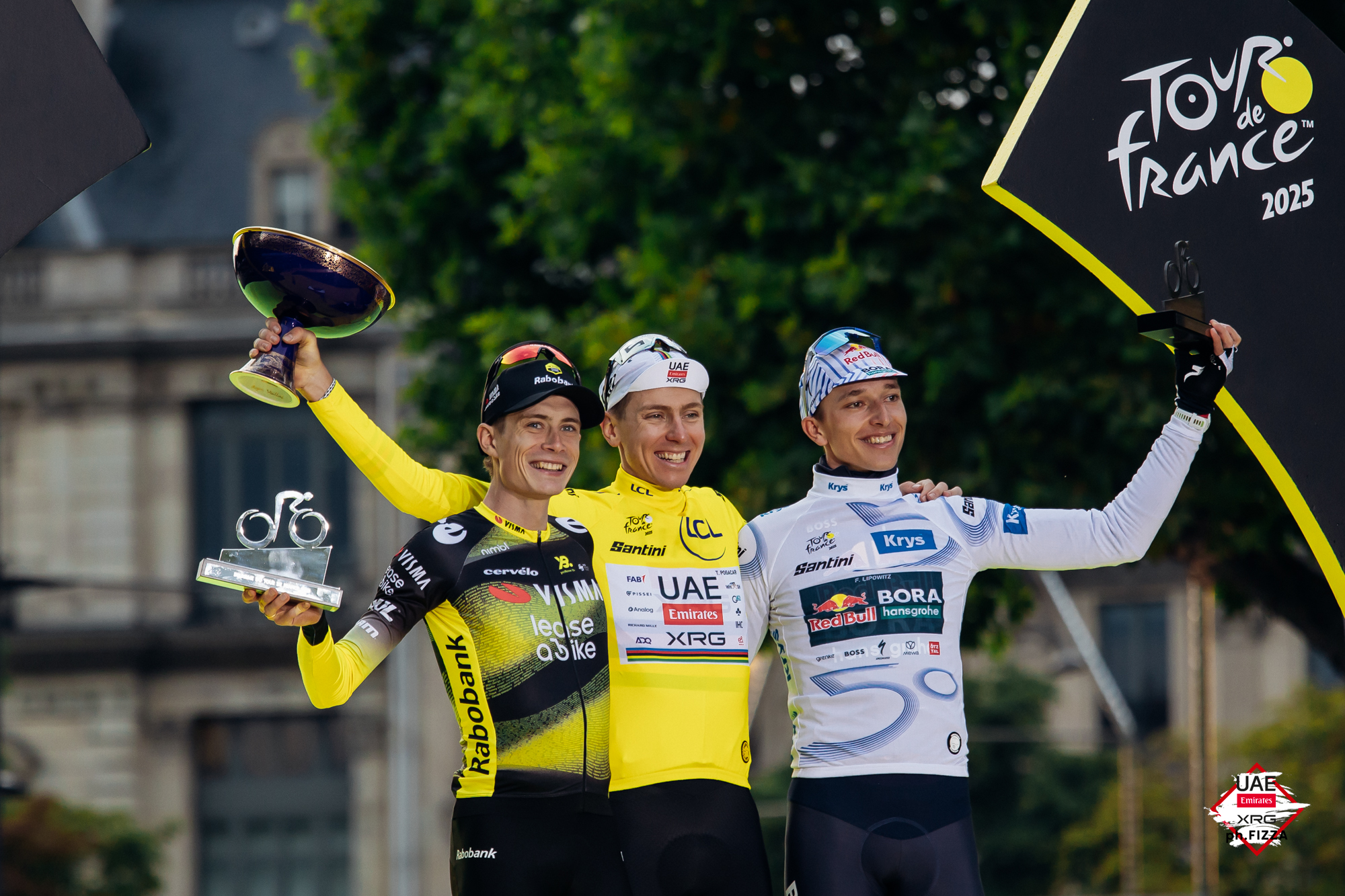
Full of motivation to raise their arms to the sky in Paris once more, Pogačar and his UAE Team Emirates-XRG teammates will begin their title defence 830km south, in Barcelona. In fact, the first three stages of this year’s Grand Départ will all take place in Catalunya, with Barcelona hosting the opening stage on Saturday, 4 July.
There, the race will get underway in spectacular fashion with an evening team time trial around the city centre. Across 19.6km, the first yellow jersey of the Tour will be awarded, with every single team preparing for this task for months in advance. The general classification contenders will all note the importance of getting off to a good start, and there will be no place to hide in the race against the clock.
As has been seen at Paris-Nice and the Tour Auvergne-Rhône-Alpes to great entertainment earlier this year, the rules of the TTT will be that each rider is awarded individual times. As such, there is no need for a minimum set of riders to reach the finish line together, opening up the possibility of GC leaders going off on their own towards the end of the route, where two tricky climbs appear.
Time will tell whether individual strength can outweigh a unified team, though.
For UAE Team Emirates-XRG, both Großschartner and Politt can look forward to pulling on their newly-made skinsuits, having won the National Time Trial Championships of Austria and Germany, respectively.
Once the TTT is out of the way, Barcelona will feature heavily again on stage 2, with a 168km-long route that begins in Tarragona but ends with three hilly laps around Montjuïc. The final ramps to the line stretch out for 700m at an average gradient of 7%, promising an entertaining fight between the puncheurs.
To end the Catalan Grand Départ, the climbers will come to the fore across the 3,989m of climbing that will come to define stage 3 between Granollers and Les Angles in the French Pyrenees. Finishing at the ski resort of Pla del Mir, stage 3 will take the peloton into France and end at the top of a 7.7km-long climb at 3.7%.
The first full stage in France will see the breakaway likely given its due, as is so often the case in Foix, which will host the finish of stage 4. More well-trodden ground will continue on stage 5, with a bunch sprint to be expected in the city of Pau, hosting the finish of a Tour de France stage for a whopping 64th time.
For new horizons, then, one must only look to stage 6, with a first-time finish at Gavarnie-Gèdre. The 186.2km-long stage will head for the mountains, with the likes of the Col d’Aspin and Col du Tourmalet adding up to some 4,163m of climbing across the day. On paper, this is one of the most demanding stages of the race, but the relatively modest final 20km may struggle to separate the big contenders.
Two pan-flat days will follow, between Hagetmau and Bordeaux on stage 7, and Perigueux and Bergerac on stage 8, before the Tour crosses the Corrèze on the last stage of the final week.
Stage 9 leads into the first rest day on Monday, 13 July, with the Tour returning with a bang on Bastille Day.
Aurillac will host the start of stage 10 on Tuesday, 14 July, with thousands of fans expected to flock to the roadside on the French national holiday. Le Lioran will host the finish, but not before the peloton is tasked with almost 4,000m of climbing in the Massif Central. This stage is very similar to that of two years ago, with the Puy Mary Pas de Peyrol and the Col du Pertus featuring in the finale.
Once more, two sprint stages will follow this challenging affair. Stage 11 runs from Vichy to Nevers, with stage 12 coming to an end in Chalon-sur-Saône.
A category one ascent tops out with 30km to ride on stage 13, and this rolling parcours between Dole and Belfort is the longest of the race, at 205.7km. With this in the legs, the riders will be treated to back-to-back mountain stages on the penultimate weekend of the race.
It is on stage 14 that the Tour de France heads into the Vosges Mountains for a summit finish at Le Markstein Fellering. Although the ski resort lies at the end of a 6km false flat, the preceding 3,855m of climbing, and in particular, the 6.3km at 7.8% that precedes the plateau will more than leave their mark.
Before the second and final rest day, stage 15 will throw up another melody of mountains between Champagnole and Plateau de Solaison. There is a little under 4,000m of elevation gain in the 183.8km-long stage, with the last 11.3km averaging 9%. The ramps of up to 14% should certainly draw out fireworks as the second week draws to a close.
A final day for rest beckons on Monday, 20 July, and just as well, because there is no let-up through the final week of this year’s Tour.
The race’s only individual time trial will kick things off on stage 16, raced across 26.1km from Évian-les-Bains to Thonon-les-Bains. Just as with the team time trial in Barcelona, this will be a course that creates precious gaps between those with an eye on the final podium in Paris.
The first 10km of the stage 16 ITT are exclusively uphill, with an average gradient of 4.1%. Once the riders have climbed up to Larringes, with a view over Lake Geneva, a quick downhill will take them into a flat final 9km stretch. The profile of this test against the clock appears to suit the time trial specialists who can exert maximum power when stationed on the skis.
Stage 17 from Chambéry to Voiron is no easy day in the saddle – there is over 2,000m of elevation gain – but the relatively flat 80km will offer hopes to the sprinters that they will get their chance. From here until Paris, it will be a game of survival for the fast men, as the general classification contenders face a date with destiny in the Alps.
At 185.1km in length, stage 18 is the longest of the three mountain stages to come, but on paper looks to be the most manageable. The final climb to Orcières-Merlette stretches out for 10.2km at 6%, which pales in comparison to the 8% average gradient of Alpe d’Huez’s famous hairpins.
Falling at the end of stage 19, the 21 hairpins of Alpe d’Huez will make their grand return on the penultimate day in the mountains, but the 2026 Tour de France returns to this well not once, but twice.
It will be on the back side of Alpe d’Huez that the Tour’s final podium will likely be decided on stage 20, with the Tour’s roadbook referring to a second successive summit finish on the mountain. In truth, the last day of racing in the mountains draws to a close on the slopes of the Col de Sarenne for the most part, before nipping across to the climb’s more famous neighbour for the final 3.8km.
The Col de Sarenne will be well known to those cyclo-tourists who have visited the Alps, with its punishing slopes tried and tested by riders keen for a challenge but without the hustle and bustle of Alpe d’Huez. Stretching out for 12.4km at 7.3%, the Sarenne is a mighty mountain in its own right, and just a 10km stretch will separate its summit from the brief return to Alpe d’Huez for the stage 20 conclusion.
That is not to underestimate what comes before the Col de Sarenne/Alpe d’Huez duo. The 170.8km-long stage sets out from Le Bourg d’Oisans on the morning of Saturday, 25 July, and heads straight for the 24km-long ascent of the Col de la Croix de Fer. This is before the Col du Télégraphe and the Col du Galibier rear their heads, making the Queen stage an eye-watering challenge with 5,432m of elevation gain.
From the top of Alpe d’Huez, it will be an overnight dash to the north of France for the Tour’s caravan. Stage 21 will finish on the Champs-Élysées of Paris, as is tradition, with the added spice of the Côte de la Butte Montmartre once again featuring. Following on from its entertaining debut in last year’s edition, the 1.1km-long cobbled climb will be used three times, the last ascent of which will top out with 6.1km to ride.
It was here that the Tour de France bore witness to a fantastic showdown between Tadej Pogačar and Wout van Aert in 2025, and with a bit of luck on the weather front, stage 21 could even play a role in the general classification battle this time out. It will be there, on the Champs-Élysées, that the winner of the 113th Tour de France will be crowned.